

Data Preview 2 (DP2)#
The official definition of Data Preview 2 (DP2) is provided in
RTN-111.
In addition, the Community Science Team have produced a database file
of observational metadata,
available in the Rubin Science Platform,
along with a tutorial notebook that demonstrates how to query,
load, and visualize the metadata (Commissioning/101_LSSTCam_visits_metadata).
An executed version of the tutorial is available in the Prompt Products documentation.
Survey Configuration#
DP2 primarily contains observations coming from early commissioning and SV survey data, thus has considerable overlap with the summary posted in Summary 20250930. It also contains observations obtained during the Pre-LSST period from October 24, 2025 to January 6, 2026, although unless these overlapped existing commissioning and SV areas, they were not combined into coadds.
While the SV data was intended to mimic standard LSST observations, it was necessarily compressed in cadence in order to reach depths suitable for testing coadds within the short period of the SV survey timeline. The Pre-LSST data is primarily aimed at providing a testing ground for additional image quality and survey speed, and as such has been released to cover the full LSST footprint. However, to support image quality testing, at times the survey configuration may also have additional constraints, either in altitude limits, in the bandpasses available, or in terms of additional observations inserted after filter changes. As the Pre-LSST observations also share time with other engineering activities, the overall cadence is also significantly lower than would be expected in full LSST surveying mode.
Visit Database#
A pointing database similar to the one released at the end of the SV survey is available for download from :
dp2_visits.db
md5sum : 7ffddd4e552e93d02ef797d6ec7e5138
sha256 : 3ff666cbfe4052db82b864cafdd85332fb55b47e7d7f80e5276866811e3afba6
Note that not all detectors or visits may end up processed successfully through all DP2 pipelines. The visit database represents the set of visits that were included in the DP2 inputs and successfully made it to some early pipeline stage. Compared to the lsstcam_20250930 linked from Summary 20250930, 1217 out of the original 21647 are not part of the DP2 visit list, and have been found to be bad for a variety of reasons (primarily being out of focus or trailed). This leaves 20430 SV survey visits contributing to DP2.
As described in RTN-111, not all visits will be included in the coadds or used to create templates. Visits with FWHM > 1.7 arcseconds or effTimeZeroPointScale (an estimate of total extinction in the image) > 0.75 may be included in the coadds, although additional detector-level cuts are possible. Approximately 16317 SV visits meet these constraints.
Including all commissioning, SV and Pre-LSST visits, the DP2 visit list encompasses 28698 visits in total.
Data Acquisition#
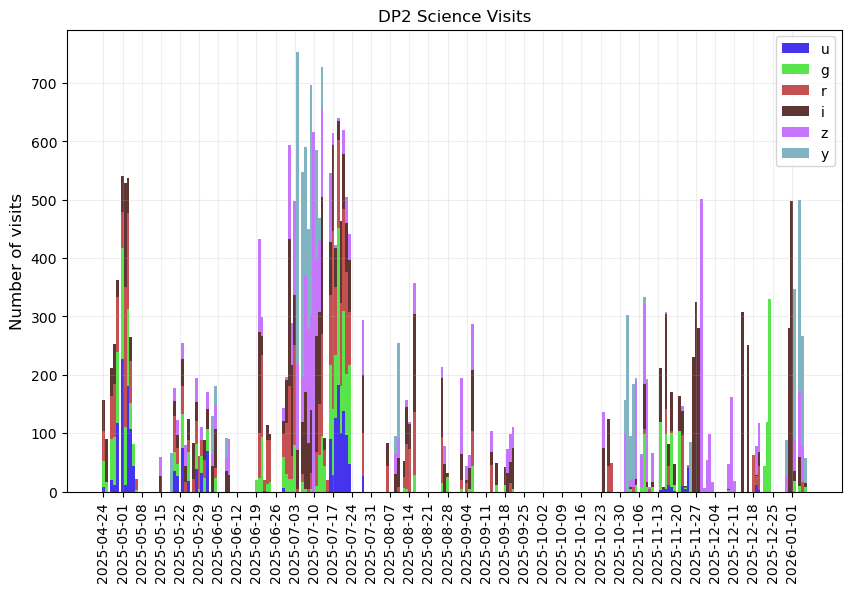
Timeline of science visit acquisition for DP2.#
The timeline of visit acquisition over the commissioning and SV period has been covered previously, but the period from October 2025 to January 2026 contains a variety of Pre-LSST observations.
Notably, there were a significant number of i band images acquired toward the end of October. This was a period of AOS testing, exploring the impact of (not) changing the filter. There were occasional similar tests during the next few months, although often staying in the same bandpass was a choice coming from the Feature Based Scheduler itself, as it attempted to gather coverage in the best bandpass for a single night in order to attempt building templates.
During much of the Pre-LSST survey, while the FBS activity on-sky has been quite intermittent (thus making it difficult to expect a regular cadence of visits), the FBS has been configured with a single-visit template tier. This template tier became a priority during commissioning when the SV survey struggled to acquire visits sufficient to build templates.
This does have implications for the cadence of observations in DP2 however. The bulk (70%) of DP2 visits come from the SV survey and DDFs, thus have a higher cadence than LSST; the Pre-LSST visits have a lower cadence than LSST and may be further perturbed in cadence due to bandpass constraints.
Coverage#
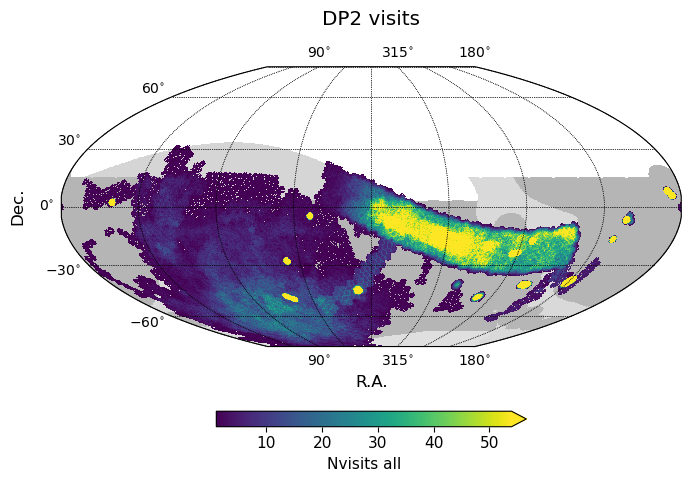
Number of DP2 visits, all bands.#
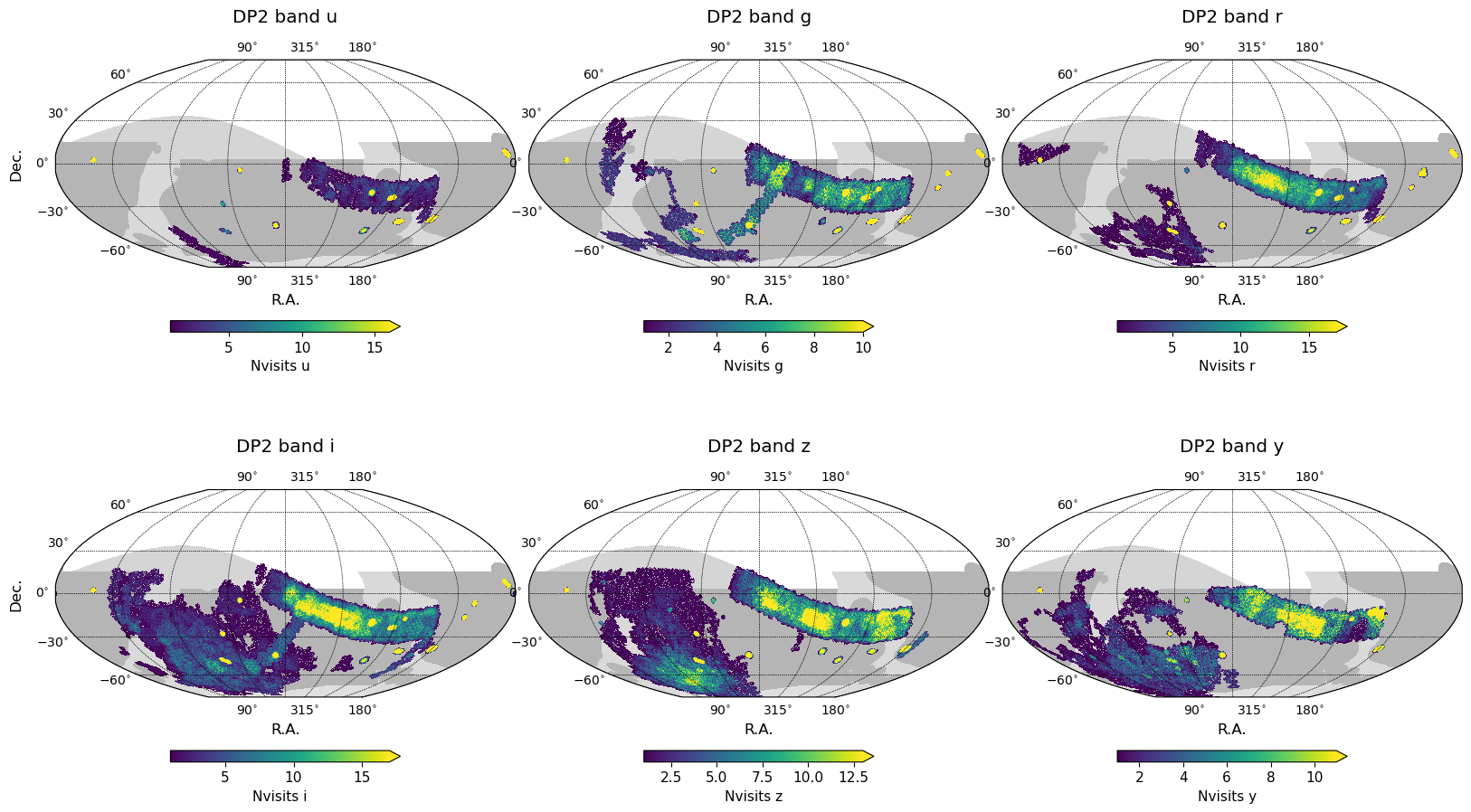
Number of DP2 visits, per band.#
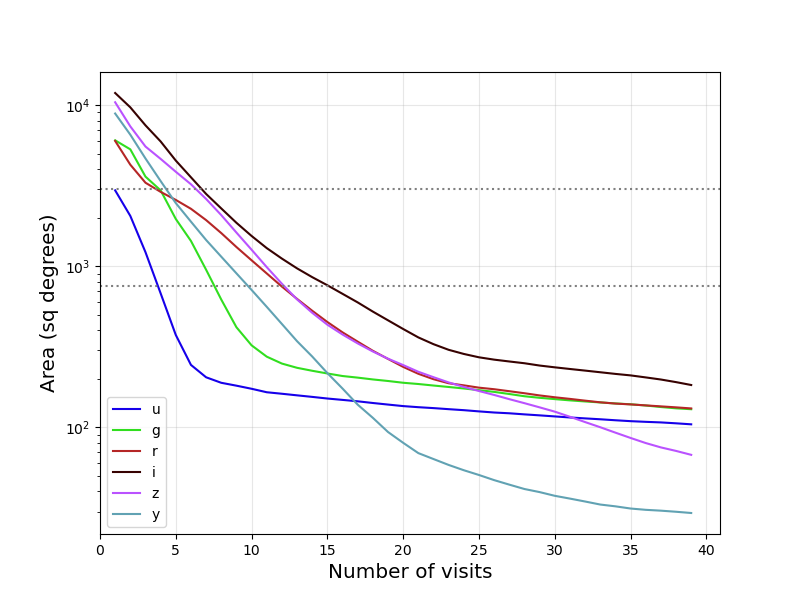
Area covered with at least X visits per band in DP2.#
Estimated image quality#
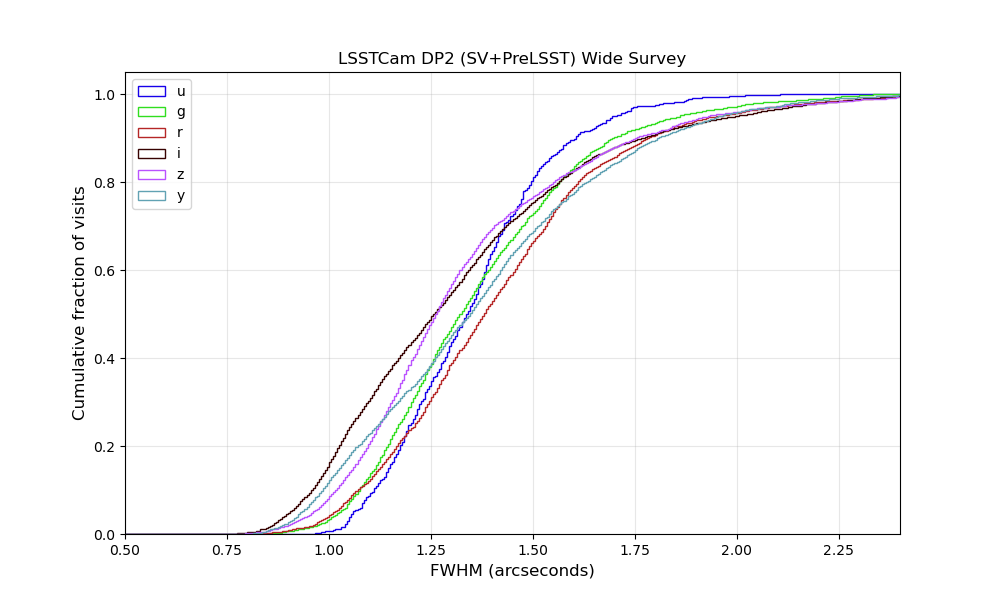
The distribution of estimated FWHM for DP2 wide (SV and Pre-LSST) area.#
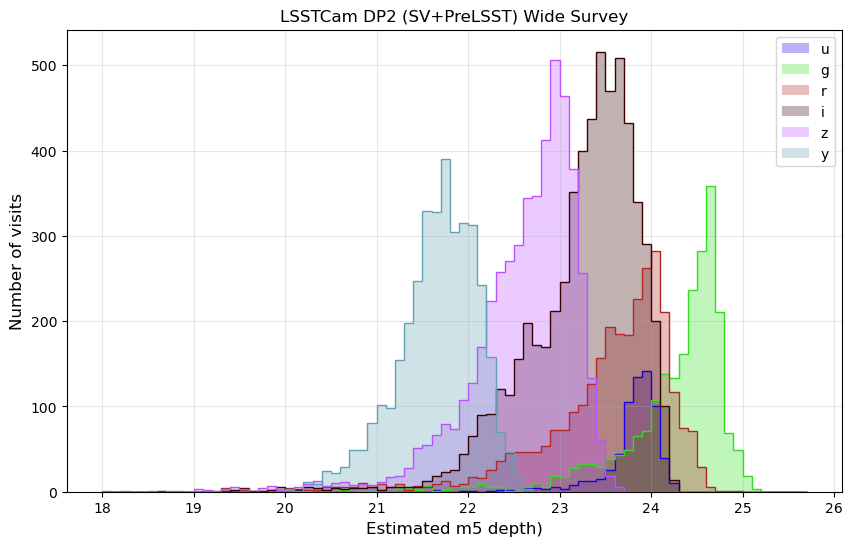
The distribution of estimated 5-sigma PSF magnitude limit for DP2 wide (SV and Pre-LSST) area visits.#
The FWHM and point-source 5-sigma limiting magnitude values above come from the
real-time Rapid Analysis QuickLook processing that occurs on the summit.
This processing provides real-time feedback for the AOS pipelines and other uses.
Different data management processing pipelines use different configurations and can
result in different values for FWHM or m5, due to many factors, including the selection
of input stars for calibration. The actual DP2 values will likely be similar, but should
be expected to show some differences, particularly when evaluating a particular visit or
detector.
Last Updated
Last Updated 2026/07/24